



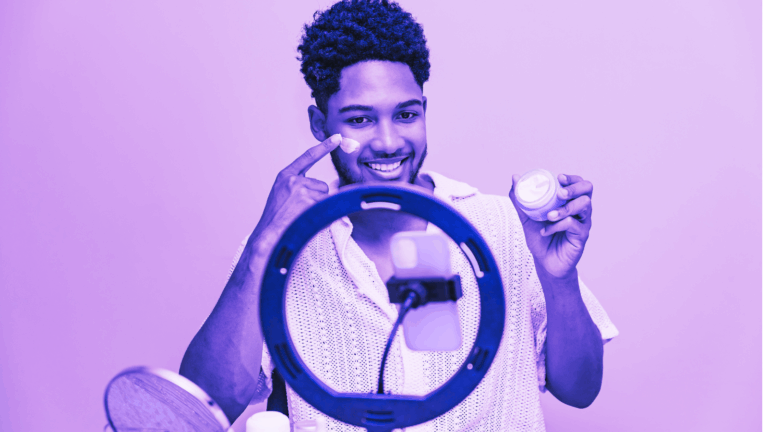
“PRISM empowers people interested in the creator and influencer space in two ways. One is relating to influencers and creators in a way similar to journalists. But it also helps communicators build their own audiences and content strategies.”
— PRISM Program Director Burghardt Tenderich
For much of the 20th century, public relations revolved around an ecosystem in which a limited number of media outlets served as the main gatekeepers of public attention. Today, that ecosystem has fractured and expanded into a far more complex environment, one filled with opportunities — but only for those prepared to navigate its challenges.
Audiences now gather around creators, influencers and community voices across social platforms, podcasts and digital networks. Earned media — attention gained through third parties and public interest rather than paid advertising — has evolved to encompass a broader and more dynamic set of relationships. Recognizing this shift early, USC designed the online Master of Science in Public Relations Innovation, Strategy and Management (PRISM) to prepare professionals to lead in this ever-changing arena.
Launched in fall 2023 by the USC Annenberg School for Communication and Journalism, PRISM reflects the reality that public relations is no longer defined solely by pitching stories to traditional outlets but by understanding influence wherever it lives.
For current and future communicators, relevance depends on navigating both legacy credibility and emerging influence — often at the same time.
Success in a Shifting Landscape
Burghardt Tenderich, founding faculty director of PRISM and professor of practice at USC Annenberg, traces the transformation to two intersecting forces: the contraction of traditional newsrooms and the rise of the social web.
“The media environment has drastically shifted in the last 25-plus years,” explains Tenderich, who is also associate director of the Annenberg School’s Center for Public Relations. “There are far fewer journalists today, and conversations are now driven by a much broader group of individuals — potentially anybody who participates in the social web.”
That shift gave rise to what is often called the content and creator economy, where influence is no longer limited to institutional media voices. For communicators, this demands a new skill set — one that blends classic earned media principles with creator relationship management, content strategy and data-informed decision-making.
With such foundational knowledge, Tenderich notes, “in addition to working in social and independent media, our graduates have gone on to work at such organizations as Apple TV, NBCUniversal, Live Nation, the Canadian Broadcasting Corporation and other major outlets.”
Earned Media — Old and New
Rather than treating influencers as a marketing afterthought, PRISM integrates them directly into its conception of modern public relations. Tenderich describes the approach as an extension of traditional media relations.
“PRISM empowers people interested in the creator and influencer space in two ways,” he says. “One is relating to influencers and creators in a way similar to journalists — essentially media relations for influencers. But it also helps communicators build their own audiences and content strategies.”
Courses such as Influencer Relationship Management formalize this evolution, while Multiplatform Content Creation equips students with hands-on skills in developing and distributing content across paid, earned, shared and owned channels. Data-Driven Brand Storytelling ensures that creativity is matched with analytical rigor, allowing students to understand not just what resonates — but why.
“I learned a great deal about channel-specific best practices and maximizing big-picture strategies across paid, earned, shared and owned media,” notes Jeremy Maskel ’25. “Getting that macro- and micro-level focus strengthens our abilities in whatever role we may have.”
But the program also emphasizes the human touch, according to Steven Reed ’25, who currently works at Google as an account strategist. “PRISM illuminated new ways I could apply my skills through a more ethical, human-centered lens,” he says. “As a result, I’m intentionally shifting toward roles that emphasize strategic communication, partnerships and influence.”
Applicable Education
A defining feature of PRISM is its practitioner-led faculty model. Program faculty work full time in the industry, bringing actual case studies, current platform shifts and evolving best practices directly into the classroom.
“This is a highly dynamic industry,” Tenderich says. “We constantly update our syllabi to make sure the content stays relevant.”
That immediacy is especially important in influencer- and creator-focused work, where platforms, algorithms and cultural norms can change overnight. Students are encouraged to apply what they learn immediately, often bringing concepts from class directly into their workplaces.
“What we keep hearing from students,” Tenderich says, “is that they literally bring concepts they learned to work, and they’re being implemented there.”
“Each class has challenged me and taught me something beyond the curriculum,” Maskel confirms. “I knew I was excited to learn the material, but I did not realize how immediately relevant the content would be for me at work, or how deeply I would connect with the projects we were completing.”
“These classes weren’t just theoretical — they were transformative,” adds Andre Lapeyrolerie ’25. Of the faculty, he says, “Their real-world experience brought key concepts to life.”
“This program encompasses so much more than merely public relations,” says Gabriella Setti ’25, a press intern at the entertainment marketing agency Walker Drawas. “It covers marketing, economics, investor relations, crisis communication, advertising, content creation, branding and influencer management. With this degree under your belt, you have the entire world of communications at your fingertips.”
Influencer Impact
Few practitioners have witnessed this transition as directly as adjunct professor Tiffanie Petett, whose career began in digital publishing just as creators started rivaling traditional outlets in reach and influence. Now an executive leading strategic partnerships at the social media company Influential, Petett sees the rise of creators as a natural evolution of earned media in the information age.
“In many ways, influencers function like a new kind of media outlet,” Petett says. “They have built-in audiences, credibility with their communities and the ability to drive real action.”
Petett’s course, Influencer Relationship Management, draws directly from her experience working across talent management, brand partnerships and data-driven influencer strategy. Students examine how influence operates culturally and ethically, how campaigns succeed or fail, and how performance can be measured beyond surface-level metrics.
The course also reflects the broader change that influencer relations are no longer confined to public relations departments. “It now intersects with social media, performance marketing and brand strategy,” Petett notes — a reality that PRISM prepares students to navigate.
Future Focused
Beyond creators and earned media, PRISM explores the emerging technologies shaping the future of communication. Students examine artificial intelligence, data automation and other Web3 technologies, including decentralized systems that are reshaping how online information is created, validated and distributed.
Given the speed of innovation, such understanding is crucial, according to Tenderich. “The level of disruption we’re seeing with AI will be comparable to when the web went mainstream,” he observes.
Rather than isolating these topics, the PRISM program weaves them throughout the curriculum, reinforcing ethical considerations and strategic responsibility alongside innovation.
“We were encouraged to look beyond the immediate, questioning the industry’s next steps and broader implications,” says Kera Patarawong ’25, whose experience includes public relations and brand experience management. “In doing so, we didn’t just keep pace with the field; we set the tone for its evolution.”
Keeping Connected
PRISM’s online format, which expands access to students everywhere, focuses on interaction and collaboration as close as those seen in any in-person classroom. Weekly live sessions, group projects and active discussion are central to that experience.
Lapeyrolerie highlights the camaraderie that emerged through group chats and team projects. “It gave the online experience a true campus vibe,” he says.
“The most meaningful highlight of my time in PRISM has been the relationships formed with both my cohort and my professors,” Reed says. “I’ve made actual connections and friendships that extended beyond virtual classes.”
“We go beyond geographic boundaries,” Tenderich explains, “but we also create a learning environment that feels connected, even when students are dispersed across regions and time zones.”
The result is a cohort model that mirrors today’s professional reality — distributed teams collaborating across platforms and disciplines.
As earned media continues evolving, PRISM positions graduates to operate across legacy media outlets, creator ecosystems and emerging platforms alike. The goal, Tenderich says, is not to chase trends but to foster adaptable leaders.
“There has never been a better time to enter this industry,” he notes. “You will be part of that change. In fact, the only constant in your professional life will be change.” But graduates know that USC’s online PRISM program prepares them not to just take advantage of such transformations but also to help shape them.